
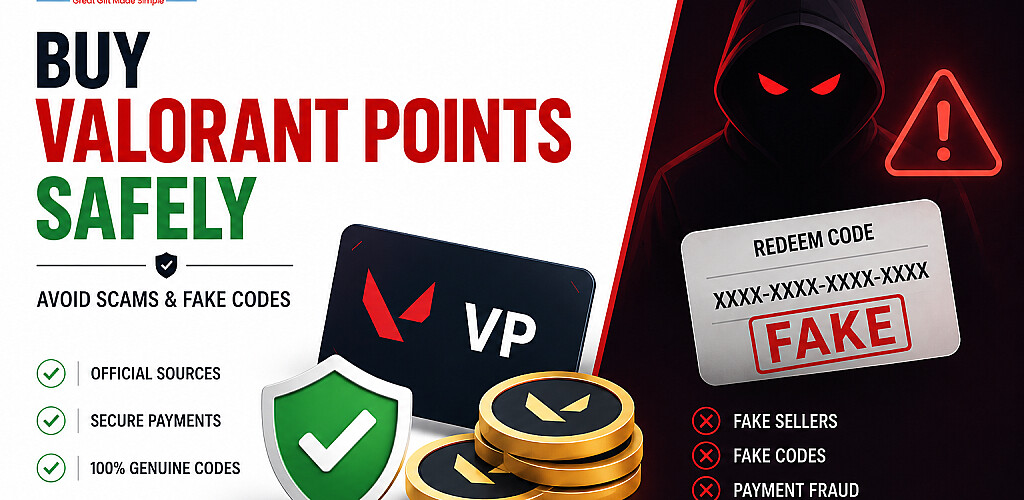
How to Buy Valorant Points Safely in Nepal (Without Getting Scammed)
- Posted by: Sasto Gift Card
Valorant has quietly become one of Nepal's most popular competitive shooters, both at gaming cafes and at home. On a weekend evening, walk into any cyber café in Kathmandu, Pokhara, or Biratnagar, and half of the PCs are likely running Radiant-hunting five-stacks or duo queue grinds. The game is free, the skill ceiling is massive, and the agency roster keeps the meta interesting enough that people stick around for years rather than months.
That popularity of Valorant produced a dilemma no one anticipated: a genuine demand for Valorant Points (VP) and no clear, legitimate means for Nepali gamers to pay for them in local currency. Riot Games does not presently offer Nepal as a directly billed region with local payment support, therefore gamers must either use international payment methods or turn to resellers. And where there is unmet demand and confusing official routes, scammers appear quickly.
Over the last two years, Nepali Valorant communities on Facebook and Discord have quietly filled with stories that follow the same pattern: someone found a "seller" offering VP at half price, paid via eSewa or bank transfer, and received nothing back, or worse, their Riot account was banned a few weeks later for reasons they didn't understand.
This handbook exists to close that gap. It explains how Nepali gamers can acquire VP with the least amount of danger, how common scams work, and how to distinguish between a reputable and a fraudulent seller before sending a single rupee. Nothing here is intended to intimidate you; instead, the purpose is to provide a calm, realistic playbook that you can actually follow.
What Are Valorant Points, Exactly?
Valorant Points (VP) are the premium currency within Valorant. You cannot earn them by playing; they must be purchased with actual money, either directly from Riot or, in territories without direct billing, through resellers who buy VP in bulk from a supported region and pass it on to players.
VP is spent on:
- Weapon skins cosmetic reskins for guns, ranging from simple recolors to fully animated, sound-replacing bundles
- Bundles themed collections of skins, often released for a limited time in the shop
- Battle Pass the seasonal progression track that unlocks skins, gun buddies, sprays, and titles as you play (the premium tier costs VP; a free tier exists too)
- Night Market a recurring, randomized discount shop that appears periodically with individual player-specific offers
- Agent unlocks (in some cases) although most agents can also be unlocked with free in-game currency (Kingdom Credits) over time
None of this affects competitive balance. Buying VP never buys rank, aim, or an advantage in a gunfight, it's purely cosmetic and progression-convenience spending. That matters because it also means there's no legitimate reason to rush a purchase under pressure, which is exactly the pressure scammers try to manufacture.
How Players Usually Buy Valorant Points
There are four broad channels players use worldwide:
- Direct purchase through the Riot Client or in-game store card or supported local payment method, VP lands instantly
- Riot Games gift cards physical or digital cards bought from a retailer and redeemed with a code
- Authorized regional retailers partners Riot has approved to sell prepaid game credit in specific countries
- Third-party resellers independent stores (often region-specific) that buy VP in bulk from a supported region and resell it, usually accepting local payment methods Riot itself doesn't support
For most of the world, option 1 is the default. For Nepal, because there's no direct local billing, options 2 and 4 do most of the heavy lifting which is also exactly where risk concentrates.
Can You Buy Valorant Points in Nepal?
Yes but not in one simple, fully official step the way a US or Indian player might.
Here's the honest picture:
- Nepal isn't a directly billed Valorant region. There's no "select NPR, pay with local card" option sitting inside the Riot store the way there is for supported countries.
- Most Nepali players use the India or Singapore server, since Nepal doesn't have a separate Valorant server, and VP for those regions is what local resellers typically stock.
- International cards work if you have one. If your bank issues a Visa or Mastercard capable of international transactions, you can sometimes purchase directly, subject to Riot's regional store settings and your bank's foreign-transaction policies.
- Riot Games branded gift cards bought from a legitimate international retailer (physical or digital) are a genuinely official route, redeemable inside the client.
- Local resellers who accept eSewa, Khalti, or IME Pay have grown popular precisely because they solve the "no local payment method" problem. Several operate long-standing, reviewed storefronts. This can be a reasonably safe option but the entire second half of this guide exists because "reseller" is also the exact costume scammers wear.
The practical reality most Nepali players land on: gift cards when available, a small number of vetted local resellers when not, and healthy skepticism toward anyone new.
Digital gift card stores like Sasto Gift Card fall into the "gift card" category above rather than the riskier peer-to-peer reseller category they sell Riot-branded Valorant gift cards priced in Nepalese Rupees, delivered digitally, and redeemed through Riot's own official redemption portal (prepaidcards.riotgames.com), which means the VP itself comes from Riot, not from a middleman's stock. That's a meaningfully different risk profile from a Facebook page taking a personal wallet transfer, and it's worth knowing the distinction exists before you choose where to buy.
Common Valorant Scams Targeting Nepali Players
Scammers don't need to be clever. They need volume, urgency, and a platform where reporting is slow. Here's where they operate and how each pattern works.
Fake Facebook Stores
A Facebook page is set up, screenshots of "successful deliveries" are posted, and VP is offered at a price that is 30-50% lower than that of any authentic supplier and add tagline like “Valorant- Buy at cheapest price” Payment is transferred to a personal eSewa or bank account. After payment, the page either becomes quiet, deletes the message, or blocks the buyer.
Why it works: Facebook pages look established because of comment counts and shares both of which are trivially fake or bought.
Instagram DM Sellers
Similar mechanics, however the vendor generally initiates contact by sliding into a gaming meme page's comments or DMing individuals who have uploaded Valorant content. The DM chat feels more personal, which reduces guard faster than a public storefront would.
Discord Sellers and Fake "Verified" Roles
Scammers join gaming servers, often with usernames that closely resemble legitimate personnel, and offer VP in direct messages. Some go so far as to impersonate a "Verified Seller" role by exploiting a compromised account that previously had that function, or by screenshotting and reposting a genuine verified seller's message with updated payment information.
Why it works: Server-level trust ("this is a real Valorant community") gets misapplied to an individual DM, which the server owner has no control over.
Telegram Sellers
Telegram's lack of easy reporting and its use of anonymous usernames makes it a preferred venue for repeat-offender scam accounts when one is exposed, the operator simply creates a new channel.
Cheap VP / Bulk Discount Scams
Any offer much lower than the conventional reseller rate (about 10-20% for reputable bulk-buying resellers; 40%+ down should raise an eyebrow) is frequently funded using stolen payment credentials. Riot's fraud systems eventually detect these chargebacks, and when they do, the receiving account is marked, not just the scammer's.
Fake Screenshots and Fake Payment Confirmations
Scammers posing as purchasers may contact sellers with doctored eSewa/Khalti "payment successful" screenshots in order to earn VP without paying. This mostly affects sellers, but it is part of the same trust-manipulation toolset that you should be aware of if you sell or trade in gaming groups.
Fake Riot Support Accounts
An account with a Riot-style logo and a name like "Riot_Support_NP" messages players claiming their account has a billing issue, asking them to "verify" by logging into a link. This is textbook phishing (covered in detail below).
Fake Tournament and Giveaway Scams
"We're giving away 1000 VP to celebrate our anniversary; just log in here to claim" pages exist solely to collect Riot credentials. Real Riot freebies never need you to check in via a third-party website.
Account Boosting Scams
Distinct from VP scams but widespread in the same spaces: someone offers to increase your rank for a charge and asks for your password. Riot's competitive policy expressly outlaws boosting, and handing away your login also grants you complete account management; dealers routinely remove inventories or resell the account.
Compromised / Stolen Accounts Sold as "VP Included"
Some scammers sell entire accounts advertised as pre-loaded with skins and VP. These accounts are almost always stolen from someone else, and Riot's ownership-verification systems can revoke access at any time, sometimes with no notice.
Fake Valorant Codes: How They Actually Work
"Fake code" scams follow a few consistent patterns:
- Already-redeemed codes: A real code is sold to multiple buyers, or was already used once, and only the first person to redeem it succeeds, everyone else gets an error and no refund.
- Region-locked codes sold without disclosure: A code valid only for the US store, for example, sold to a player on the India/Singapore-linked account, which then fails to redeem.
- Randomly generated fake strings: Some scammers simply generate plausible-looking alphanumeric codes with no backing value at all, betting the buyer won't check before paying.
- Screenshot-only "proof": A seller shows a screenshot of a code (or of a redemption confirmation) instead of handing over the actual redeemable code or applying VP directly to your account.
Warning signs: a code that arrives with no order number or receipt, a seller unwilling to redeem it directly to your Riot ID themselves, or a seller who becomes evasive when asked which exact region the code is valid for.
Phishing and Fake Valorant Login Pages
This is the highest-stakes scam category, because it targets your Riot account credentials, not just a one-time payment.
How credential theft works
A fake page is built to visually clone the real Riot login screen. The URL is close enough to pass a glance swapped letters, an extra hyphen, a different top-level domain (.net instead of .com, for instance). When you "log in," the page silently forwards your username and password to the attacker, then either shows an error or redirects you to the real Riot site so nothing feels wrong.
How to check before you type your password
- Look at the actual URL bar, not just the page design. The only legitimate Riot login domains are riotgames.com and playvalorant.com and their direct subdomains are never a lookalike domain.
- Confirm HTTPS and a valid certificate, but remember HTTPS alone doesn't prove legitimacy. Scam pages can have valid certificates too. It's a minimum check, not a full guarantee.
- Never log in through a link from Discord, email, or Facebook. Open a browser and type playvalorant.com yourself, every time.
- Distrust urgency. "Your account will be suspended in 24 hours unless you verify" is a manufactured deadline designed to short-circuit careful thinking.
Email scams
Phishing emails impersonating Riot support frequently include a bogus "unusual login" or "purchase confirmation" to elicit a frantic click. Riot will never request your password by email, and genuine account emails do not need you to "confirm" by inputting credentials on an external page.
QR code scams
A newer pattern: a QR code posted in a Discord server or on a poster claims to link to a giveaway or login page. Scanning it bypasses the visual habit of checking a URL bar, since most phones show a shortened or truncated link. Treat QR codes from unknown sources with the same suspicion as unknown links.
Download Valorant Safely
Valorant should only ever be downloaded from playvalorant.com directly. A few reasons this matters more than it might seem:
- Modified installers can bundle malware. "Faster download" or "pre-cracked" installers circulating on forums or torrent sites are a common vector for trojans and keyloggers.
- Keyloggers silently record everything you type, including your Riot password the next time you log in completely separate from any phishing page.
- Valorant's anti-cheat (Vanguard) runs at a deep system level, which is precisely why an unofficial installer is riskier than it would be for an ordinary application a compromised installer has more to work with.
If a download source isn't the official Riot domain, it isn't worth the risk, regardless of how much faster it claims to be.
How to Verify a Seller Before Paying
Use this checklist before sending any payment to a VP reseller:
- Reviews across multiple platforms, not just testimonials posted on the seller's own page. Check Facebook reviews, Google reviews if they have a registered business listing, and community mentions in Nepali gaming Discords or subreddits.
- Business history and longevity. A store that's been operating for a year or more with a consistent name and consistent contact details is lower-risk than a page created last week.
- A clear refund or non-delivery policy, stated somewhere visible, not something you have to ask for after paying.
- They only ask for your Riot ID and region, never your password. This is the single clearest signal of legitimacy versus fraud.
- Payment methods that create a paper trail. eSewa, Khalti, and verified bank transfers are traceable; requests to pay via personal mobile wallets with no order reference are a red flag.
- Social proof that predates your purchase decision, not proof manufactured in the moment (a "customer" conveniently commenting "just received mine!" right as you're deciding).
- A real, findable identity behind the store, a registered business name, a consistent WhatsApp/phone number, or a physical presence, rather than a page with no verifiable owner.
A simpler shortcut: where possible, favor stores selling actual Riot-issued gift cards over stores reselling loose VP balances. Sasto Gift Card's Valorant range is one example of a Nepal-based store built around this model you pay in NPR, receive a digital Riot gift card code, and redeem it yourself directly on Riot's own site, so you're never handing your account details to a third party at all.
Protecting Your Riot Account
Even if you never buy Valorant Points from anyone, account security matters simply because Valorant accounts are frequently targeted.
- Use a long, unique password not one reused from email, Facebook, or any other account.
- Use a password manager so you're not tempted to reuse passwords for convenience.
- Enable two-factor authentication (2FA) on your Riot account. This alone stops the overwhelming majority of takeover attempts, even if a password leaks.
- Secure the email address linked to your Riot account with its own strong password and 2FA email is usually the actual master key attackers want.
- Keep your device free of unnecessary third-party software, especially anything downloaded from unofficial Valorant-related sites.
- Set up account recovery options (backup email, phone number) before you need them, not after you've been locked out.
- Never share your credentials with anyone, not a "support agent," not a friend boosting your rank, not a seller "verifying" your account.
Should You Buy Cheap Valorant Points?
Cheap VP isn't automatically a scam. legitimate resellers genuinely can offer modest discounts through bulk purchasing and regional pricing differences. The question is where the line sits.
| Official Store / Verified Reseller | Deep-Discount Unverified Seller | |
| Typical Discount | 0–20% below face value | 30–50%+ below face value |
| Payment traceability | Full paper trail | Often untraceable personal transfer |
| Source of funds | Legitimate purchase | Frequently stolen card/chargeback fraud |
| Risk to your account | Minimal | Possible ban if VP is chargeback-reversed |
| Recourse if scammed | Refund/dispute possible | Usually none |
A 10–20% discount funded by genuine bulk purchasing is a real business model. A 40–50% discount has to come from somewhere and in this market, it usually comes from stolen payment credentials, which puts your account at risk even though you personally did nothing wrong.
Buying Valorant Skins
Once VP is safely in your account, skins fall into a few categories worth understanding before you spend:
- Permanent shop skins rotate through the daily store, purchasable individually
- Bundles themed sets (weapon + finisher effects + card + spray, etc.), available for a limited window, sometimes returning later
- Night Market a personalized, discounted rotation that appears periodically, often the best value-per-VP if you're patient
- Battle Pass exclusives tied to the seasonal pass and not purchasable individually once the act ends, though some return in bundles later
There's no competitive reason to rush a skin purchase, patience around Night Market timing tends to be the most VP-efficient strategy for budget-conscious players.
Valorant vs. Apex Legends Purchases: A Quick Comparison
Players who also play Apex Legends frequently question how Valorant Points compares to the Apex Battle Pass system. The main distinction is that Apex Legends' battle pass may often be redeemed for in-game currency if completed, mitigating the cost of future seasons, but Valorant's premium Battle Pass tier is a flat VP purchase with fewer offsetting mechanics. When it comes to buying currency from unlicensed resellers, both games face the same underlying danger; the fraud techniques outlined above apply equally to Apex Coins and VP. The safety concepts outlined in this tutorial are not exclusive to Valorant; rather, they are standard digital currency hygiene.
Practical Scam Scenarios
Scenario 1: The Fake Facebook Seller
A page posts VP at half price with dozens of comments saying "received, thanks!" A player messages, pays via eSewa to a personal number, and never receives anything. The page is deleted within days.
Why it worked: Manufactured social proof (fake comments) plus urgency ("today only" pricing) overrode the buyer's instinct to check the page's actual history.
How to avoid it: Search the page name plus "scam" before paying anything. Check when the page was created a page under a few months old selling at unbelievable prices deserves extra scrutiny regardless of comment count.
Scenario 2: The Fake Discord Moderator
Someone DMs a player in a Valorant Nepal server, claiming to be a moderator running a "private VP restock" only for active members. The urgency is social: being singled out feels flattering, and the server's real reputation gets borrowed by association.
Why it worked: Trust transferred from the community to an individual who had no actual authority to speak for it.
How to avoid it: Verify any seller claim with an actual server admin, in public, before paying. Legitimate mods rarely run private DM sales and if they do, the server usually has a pinned, verified process for it.
Scenario 3: The Phishing Riot Email
An email titled "Unusual Sign-in Detected Verify Now" links to a cloned login page. The player, mildly anxious, logs in without checking the URL, and loses account access within hours.
Why it worked: Fear of losing access short-circuited the habit of checking a URL.
How to avoid it: Never click login links in email. Open the browser, type the Riot URL manually, and check for anything unusual after logging in directly.
Scenario 4: The Fake Giveaway
A post claims Riot is giving away 1000 VP to the first 500 people who "log in to claim" through a linked page. The page looks polished, complete with a countdown timer to add urgency.
Why it worked: The countdown timer manufactured scarcity, and the professional design borrowed visual trust from real Riot promotions.
How to avoid it: Riot doesn't run giveaways that require logging in through third-party links. Any such claim should be checked against Riot's own verified social accounts before you touch it.
Myths vs. Facts
| Claim | Verdict |
| Cheap VP is always a scam | Partly false modest discounts from verified resellers are normal; extreme discounts are the red flag |
| Riot employees hand out free VP through DMs or giveaways requiring login | False this is always phishing |
| Gift cards never expire | Depends check the specific card's terms; some regions/cards do carry expiry windows |
| HTTPS on a login page proves it's safe | False HTTPS is a baseline, not proof of legitimacy |
| Sharing your password with a "verifier" is sometimes necessary | False no legitimate process ever requires your password |
| A seller who only asks for your Riot ID is automatically safe | Mostly true, but verify separately it's a strong signal, not a complete guarantee on its own |
| Buying VP with stolen-card-funded discounts can get your account banned even if you didn't know | True chargebacks can trigger account-level review regardless of buyer intent |
Printable Safety Checklist
Before buying VP:
✔️ Seller has reviews across more than one platform
✔️ Seller has operated for a meaningful length of time
✔️ Discount is modest (roughly 10–20%), not extreme
✔️ Payment method is traceable (eSewa/Khalti with order reference, not a bare personal transfer)
✔️ Seller asks only for Riot ID and region never a password
✔️ Where possible, choose an actual Riot gift card (e.g. from Sasto Gift Card's Valorant gift card range) over a loose VP top-up, so you redeem the code yourself on Riot's own site
Before entering your Riot login anywhere:
✔️ URL is exactly riotgames.com or playvalorant.com
✔️ You typed the URL yourself, rather than clicking a link
✔️ There's no artificial urgency pressuring you to act immediately
✔️ 2FA is enabled, so even a leaked password isn't enough on its own
Before redeeming any code:
✔️ You received an actual redeemable code, not just a screenshot
✔️ The code's region matches your account's region
✔️ You have an order confirmation or receipt tied to the purchase
Frequently Asked Questions
Is it legal to buy Valorant Points in Nepal?
Yes, buying VP itself isn't illegal. The legal risk sits with scammers using stolen payment methods, not with a player simply purchasing in-game currency for personal use.
Can I buy Valorant Points directly from Riot using eSewa or Khalti?
Riot's official store doesn't support these payment methods directly for Nepal. That's why local resellers exist, but it also means extra care is needed when choosing one. Sasto Gift card provides
Will my account get banned for buying VP from a third-party seller?
Not automatically. The ban risk comes specifically from VP purchased using stolen payment credentials, which triggers a chargeback later. Buying from a verified reseller using legitimate funds carries far lower risk.
Are Riot Games gift cards a safe option for Nepali players?
Yes, when bought from a legitimate retailer gift cards are one of the most reliably official routes available, since redemption happens entirely inside Riot's own client. Nepal-based stores such as Sasto Gift Card sell these in NPR with digital delivery, so you're paying locally for a code that Riot itself issues and redeems.
Is it safe to buy a Valorant account that already has skins and Valorant Points?
No, these accounts are frequently stolen, and Riot can revoke access at any time if ownership is disputed, with no guarantee of refund from the seller.

![Roblox Digital Gift Card - 3,000 Robux [Includes Exclusive Virtual Item] [Digital Code]](https://sastogiftcard.com/storage/410/conversions/Roblux-3000-thumb.jpg)



Comment